Bluebook-style Digital SAT practice
Practice the Digital SAT the way you’ll actually take it.
Full-length, timed practice tests in the same interface as the real exam — same timer, same eliminator, same highlighter. You get a 200–800 score per section, a breakdown of every domain you missed, and an explanation for every question.
Answer a real question
Module 1 · Reading and Writing
Question 1 of 3
0s
Mycorrhizal fungi thread through soil in filaments so fine that a single teaspoon of forest floor can hold several kilometres of them. Early accounts described these networks as plumbing: water and phosphorus travel one way, sugar travels the other, and the fungus is the pipe. Field measurements have complicated that account. When a seedling is shaded and short of carbon, the fungus linking it to a larger tree does not always pass along what it receives, and what it does pass along it appears to price. The fungus, on this reading, is less a pipe than a broker.
As used in the text, what does the word broker most nearly mean?
Pick an answer to check it.
Real questions from the bank. Nothing is saved and no account is needed.
See it before you sign up.
These are real screens, not mockups.

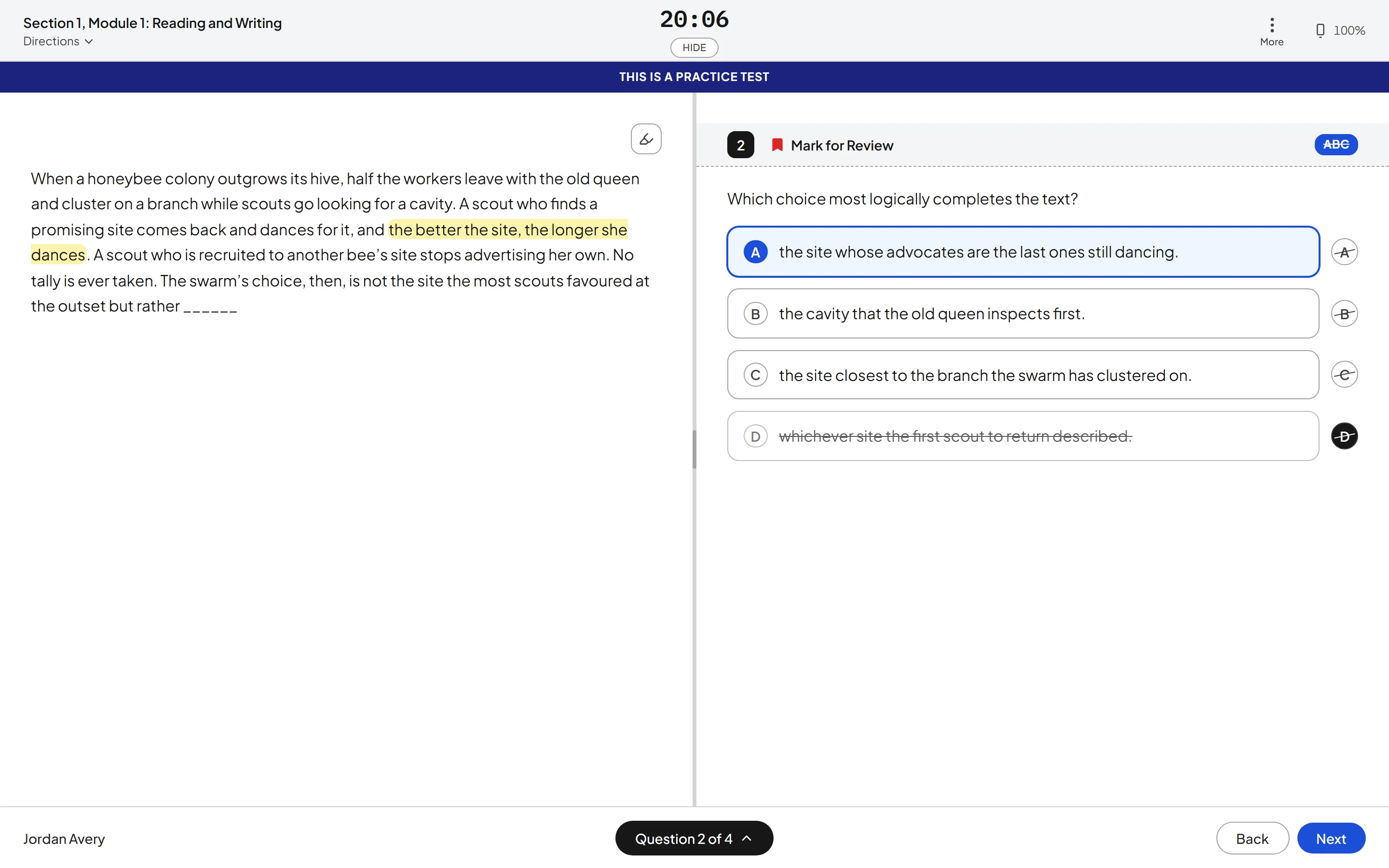
- Highlight and annotate any passage
- Answer eliminator, same as Bluebook
- Timer anchored to the server clock
What you get
Built to match the real thing
Not a quiz app with an SAT theme. The same module structure, the same tools on screen, and a score report that tells you where to go next.
Adaptive mode
Module 2 is chosen by how you did on Module 1
Do well enough on the first module and the second one is the harder set, which is the only route to the top of the scale. Fall short and you get the easier set, and that section scores out of 600 instead of 800. It is the rule the Digital SAT itself uses, and the public adaptive test here runs it.
The interface
Every tool the real exam gives you
- Answer eliminator, with the ABC toggle
- Passage highlighting, and a note on a highlight
- The Desmos graphing calculator, built in
- The geometry reference sheet
- Keyboard shortcuts for every control
- A timer the server owns — closing the tab does not pause it
After the test
A report that tells you what to do
A scaled score from 200 to 800 for each section and a total out of 1600, then the part that matters: how you did in every content domain you were tested on, the same split by question difficulty, and a written explanation on every question — including the ones you got right.
Devices
Works on an iPad
The full test runs in Safari or Chrome on a tablet — nothing to install. Built tablet-first, which is how the real exam is sat.
No sign-up wall
Start without an account
A public test is one click away, timed and scored like any other. The attempt is held against this browser by a signed cookie, so you can finish first and decide about an account afterwards.
Three easy steps
From sign-up to your first scored attempt in minutes.
- 1
Sign up and log in
Free account creation. Admin users can also be set up to manage tests.
- 2
Choose a practice test
Pick from your library of full-length or section-only practice tests.
- 3
Get your score and review
See your scaled score and walk through every question with explanations.
Scoring
We show our work
Your raw score — how many you got right — becomes a 200–800 score for each section through a fixed lookup table, and the two add up to a total out of 1600. Here is the table.
| Raw | Scaled |
|---|---|
| 0 | 200 |
| 8 | 320 |
| 15 | 440 |
| 23 | 530 |
| 31 | 610 |
| 39 | 700 |
| 46 | 770 |
| 54 | 800 |
| Raw | Scaled |
|---|---|
| 0 | 200 |
| 6 | 310 |
| 13 | 460 |
| 19 | 560 |
| 25 | 640 |
| 31 | 720 |
| 38 | 790 |
| 44 | 800 |
It is an estimate, not a score
The College Board does not publish its operational scoring model, and this does not reproduce it. Nothing here is reported to anyone, and no result from this site is an official SAT score.
A shorter test still converts
Your raw score is mapped onto the table in proportion, so a ten-question section lands somewhere sensible. It has fewer score points than a full-length one, and the report labels it as an estimate rather than hiding the difference.
The easier second module caps at 600
If a section routed you to the lower Module 2, that section is capped at 600 after the lookup runs. That is a deliberately conservative calibration by this platform, not an official curve.
For tutors and schools
The admin side is the product too
Everything a student sits is something somebody built here first. Write the questions, assemble the test, put your students in a group, assign it, then read every attempt back question by question.
A question bank you own
Write questions in the editor, tag each one with a content domain, a skill inside it and a difficulty, and attach an explanation students see in the review. Maths is typeset when you save, not in the student's browser.
Assemble tests out of it
Build a test section by section and module by module, choosing the questions in each. Set the routing threshold for an adaptive test, or leave it linear, and decide whether it is public or only for your students.
Group your students
Put students into groups, and see a group's attempts and average together rather than one student at a time.
Assign a test to a group
A test assigned to a group appears for every student in it. No links to send, no codes to distribute.
Export the lot as CSV
Every completed attempt with its scores, per-domain counts and per-question detail, in one file you can open in a spreadsheet.
Bulk import from JSON
Drop or paste a JSON tree of sections, modules and questions. You see what it parsed, and what it rejected, before anything is written.
Questions
Before you start
The eight things worth knowing, answered plainly. If something here reads like marketing, it is a bug.
Is this the real SAT?
No. This is practice, built to the format of the Digital SAT: the same two sections, the same two modules inside each one, the same on-screen tools and the same clock.
It is not affiliated with, endorsed by, or connected to the College Board, and SAT is their trademark. No score from this site is an official score, and nothing you do here is reported to anyone.
Where do the questions come from?
Every question lives in this platform's own bank and is tagged before it can be used: one of the content domains the College Board publishes, one skill inside that domain, and a difficulty. Each one also carries a written explanation, and you see the explanation on every question in the review — including the ones you answered correctly.
Nothing here is a live exam question. Live SAT content is undisclosed and stays that way, so anyone who claims to have it is either wrong or selling you something.
The sample questions on the home page and the ones shown in the screenshots were written specifically for this site.
How is the 200–800 score calculated?
Each section's raw score — how many questions you got right — is converted to a scaled score from 200 to 800 through a fixed lookup table: 55 entries for Reading and Writing raw scores 0 to 54, and 45 entries for Math raw scores 0 to 44. The values come from the released Digital SAT practice-test scoring guides. The two section scores add up to a total out of 1600.
If the second module you were served in a section was the easier one, that section's score is capped at 600. The lookup runs first and the cap is applied after. A harder or mixed second module is not capped. That 600 is a deliberately conservative calibration by this platform, not an official curve — the College Board does not publish a reusable table for the lower route.
A score needs at least one scored question in both Reading and Writing and Math. Only a test with exactly 54 Reading and Writing questions and 44 Math questions is labelled full length; any other length is shown as a short-test estimate, with the proportional lookup but no performance tier attached to it.
These are practice estimates. The College Board's operational scoring model is not published, and this does not reproduce it.
Is it really free? Do I need a card?
There is no payment step anywhere in this product. No card field, no plan to pick, no checkout — none of it is built, so there is nothing that could charge you.
You do not need an account either. A public practice test can be started, timed, scored and reviewed straight from the practice page; the attempt is held against your browser by a signed cookie. An account is what makes your history follow you to another device.
Does it work on an iPad or a Chromebook?
Yes, and there is nothing to install. The whole thing runs in the browser — Safari or Chrome on an iPad, Chrome on a Chromebook — including the graphing calculator and the reference sheet.
The test interface is built tablet-first, which is the screen size the real exam is sat on. A phone will load it, but the reading passages and the tools are cramped at that width; the score report and the answer review are comfortable on any screen.
What is the difference between adaptive and linear mode?
The real Digital SAT is section-adaptive: everyone gets the same first module, and how you do on it decides which second module you get. Do well enough and you get the harder set, which is the only route to the top of the scale. Fall short and you get the easier set, and that section is capped at 600.
An adaptive test here does exactly that, routing on a threshold set on the test itself. A linear test serves everyone the same second module and applies no cap, which makes it the better shape for drilling a fixed set of questions rather than estimating a score.
Each test on the practice page is labelled with the mode it will run in, so you know which one you are starting before you start it.
Can I use this with my students?
Yes. A tutor account manages the question bank, assembles tests out of it, groups students, and opens any attempt to see it question by question — what was answered, what was eliminated, how long it took, and where the time went.
Tutor accounts are set up by hand rather than through sign-up. Ask on the contact page and say roughly how many students you teach.
What happens to my data?
It stays here. Everything is stored in this platform's own database: the account details you enter, the answers you submit during an attempt, and the scores computed from them. There is no third-party analytics script anywhere in the app — no pixel, no tag manager, nothing that reports to another company.
Product usage is counted as events, and an event holds only ids, labels and numbers — which test was started, which module was completed, whether the attempt was anonymous. It never holds your answers, your notes or your highlights, and no IP address is recorded anywhere.
One cookie does the counting. It holds a random id, cannot be read by page scripts, lasts 180 days, and is there so a sign-up can be joined to the attempt that came before it. It is not used for advertising, and nothing here is sold or shared with advertisers.
Still deciding? Take a practice test without an account, read how the score is worked out, or ask something that is not here.
Start your first timed test
An account keeps your attempts, your score history and your weakest domains in one place. It takes an email and a password, and there is no payment step to get past.